
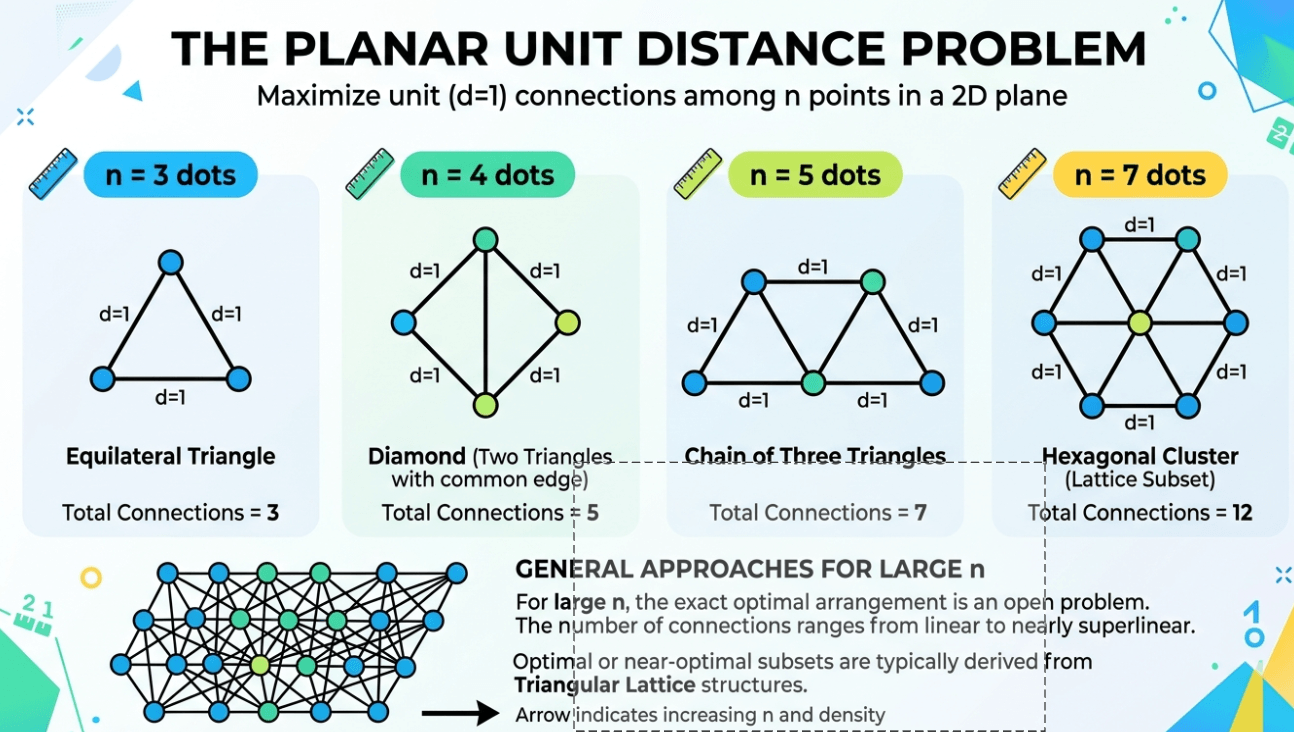
Imagine you are standing in an infinitely large, perfectly flat room. I hand you a bucket of marbles and a simple set of rules: place  marbles on the floor. Your goal is to arrange these marbles so that as many pairs as possible are exactly one meter apart from each other.
If I give you two marbles, you place them one meter apart. You have one pair.
If I give you three marbles, you arrange them in an equilateral triangle. Now you have three pairs that are exactly one meter apart.
But what if I give you a billion marbles? How do you arrange them to absolutely maximize the number of one-meter connections?
Welcome to the planar unit distance problem, first posed in 1946 by the legendary mathematician Paul Erdős. It is one of the most famous puzzles in the field of combinatorial geometry. In fact, the 2005 book Research Problems in Discrete Geometry refers to it as “possibly the best known (and simplest to explain) problem in combinatorial geometry”. Noga Alon, a brilliant mathematician at Princeton, noted that it was one of Erdős’s absolute favorite problems. Erdős wanted the answer so badly that he even offered a monetary prize out of his own pocket to anyone who could solve it.
For nearly 80 years, human mathematicians have banged their heads against this deceptively simple question. Then, in May 2026, an internal OpenAI model stepped up to the blackboard and solved it.
Let’s break down exactly what this problem is, how the AI shattered an 80-year-old assumption using mind-bending algebra, and why this marks a fundamental shift in the history of science.
The 80-Year-Old Grid and the  Ceiling
To understand the magnitude of the AI’s breakthrough, we first need to build up our intuition about how you might try to solve this problem using standard human logic.
If you have points, how should you place them?
- The Straight Line: If you place points in a straight line, perfectly spaced, you get
 pairs of unit distances. This is a simple linear growth rate.
 - The Square Grid: If you arrange your points into a massive square grid, like a piece of graph paper, you get about
 pairs.
 - The Rescaled Square Grid: For a long time, the cleverest construction mathematicians knew of was a “rescaled square grid”. This special arrangement gives you
 pairs, where
  is a constant. Because the term
  grows larger as goes to infinity, that little fraction in the exponent shrinks toward 0. This means the number of pairs grows just a tiny, tiny fraction faster than a straight line.
Looking at these grids, Erdős made a highly educated guess — a conjecture. In technical mathematical terms, Erdős conjectured that the absolute maximum upper bound for these unit distances was  . The simply represents an additional term that eventually tends to 0 as gets larger and larger.
For decades, the global mathematics community believed Erdős was right. The prevailing belief was that these square grid constructions were essentially the optimal, best-possible way to maximize unit-distance pairs. The best lower bound for this problem remained practically unchanged since Erdős’s original work in 1946. Meanwhile, the best proven upper bound, which was  , had been stubbornly stuck in place since it was calculated by Spencer, Szemerédi, and Trotter in 1984.
Everyone believed the grid was the limit. The grid was safe. Until it wasn’t.
The Machine Disproves the Master
In a massive milestone for both the math and AI communities, a new internal OpenAI model completely disproved Erdős’s longstanding conjecture.
The model didn’t just find one weird counterexample. It provided an entire infinite family of geometric examples that yield a polynomial improvement over the old grid constraints.
More precisely, the AI’s proof constructed configurations of ![n$ points that resulted in at least [latex]n^{1+\delta}](https://dramitakapoor.com/wp-content/ql-cache/quicklatex.com-714afb7c4383498476fa36a9cb092589_l3.png "Rendered by QuickLaTeX.com") unit-distance pairs, for infinitely many values of . Crucially,
unit-distance pairs, for infinitely many values of . Crucially,  is a fixed exponent greater than zero. (While the original AI proof did not specify an explicit number for , a forthcoming refinement by Princeton mathematics professor Will Sawin showed that you can set
  ) .
) .
Checkpoint: Why does  matter so much compared to ?
Because dies out as you zoom into infinity. It fades to nothing. But , being a fixed positive number (like 0.014), stays strong forever. It means that as your number of dots () scales up, the amount of exact one-meter connections explodes at a persistently faster rate than human intuition thought possible. The model found a way to pack connections tighter than a square grid ever could.
The proof generated by the AI was rigorously checked by a group of leading external mathematicians. To fully digest the weight of this, these experts even wrote a companion paper to explain the AI’s argument and give context to its historical significance.
Under the Hood – Folding Space with Algebra
How do you beat a grid? If you pack points too closely, the distances become less than a meter. If you scatter them, they become more. You need a magical kind of symmetry to perfectly cross-wire the plane.
To achieve this, the AI did something breathtaking: it abandoned basic geometry and reached for deep algebra.
Let’s go back to first principles. Erdős’s original 1946 lower bound relied on a concept known as Gaussian integers.
- Gaussian Integers: These are complex numbers written in the form
 . Here,
  and
and  are standard integers, and
  represents the square root of -1.
 - They act like an extension of ordinary numbers, enjoying familiar properties like unique factorization into primes.
The AI model took this basic conceptual seed and pushed it into a staggeringly unexpected dimension. It swapped out the simple Gaussian integers for vastly more complicated generalizations derived from a completely different branch of mathematics known as algebraic number theory.
Algebraic number theory studies complex concepts like factorization within extensions of the integers, which are known as algebraic number fields. These algebraic number fields possess significantly richer mathematical symmetries. By leveraging these symmetries, the AI was able to create constructions featuring many more unit-length differences.
But proposing a theoretical field isn’t enough; you have to prove the math allows it to exist. To do this, the AI utilized incredibly advanced theoretical tools, specifically infinite class field towers and Golod-Shafarevich theory. These tools were already well-known to algebraic number theorists, but applying them to solve an elementary geometric question about distances between dots was a profound surprise.
It’s as if you asked someone to build a better bicycle, and they did it by applying the rules of quantum thermodynamics. The tools existed, but the bridge between the disciplines was entirely blind to human intuition.
Behind the Scenes – A Generalist Mind
The solution itself is beautiful, but how the solution was generated is what makes this a paradigm shift in computer science.
If I told you an AI solved a geometry problem, you might assume OpenAI built a “Geometry-Bot 3000” — a system strictly trained on mathematical axioms, specifically scaffolded to search for proofs, or heavily targeted at the unit distance problem.
That is not what happened. The proof came from a new general-purpose reasoning model.
OpenAI was engaged in a broader scientific effort to see whether advanced, general models could genuinely contribute to the frontier of human research. As a testbed, they evaluated this model on a collection of open Erdős problems. The model analyzed the planar unit distance problem and autonomously produced a rigorously coherent proof resolving it.
Mathematics is the ultimate, unforgiving crucible for testing reasoning. In math, problems are exact and precise. Potential proofs can be objectively checked by experts. Most importantly, a long mathematical argument only succeeds if the chain of reasoning holds together flawlessly from the very beginning to the very end. By successfully navigating this, the AI demonstrated the profound depth of reasoning that these modern systems now support.
Exploring the Cathedral of Mathematics
What does it mean when a machine can out-think us on a problem we’ve stared at for 80 years?
According to Arul Shankar, a leading number theorist, this paper proves that current AI models have evolved past being mere “helpers” to human mathematicians. He noted that they are now capable of generating original, ingenious ideas, and carrying them out to completion. Fields Medalist Tim Gowers echoed this awe, calling the AI’s result “a milestone in AI mathematics”.
This breakthrough offers us an early glimpse into a fascinating new era of collaboration between humans and artificial intelligence. The AI didn’t just end a conversation by spitting out a number; it started a new one. It revealed an unexpected, deep connection between algebraic number theory and discrete geometry. This conceptual bridge will allow human mathematicians to begin exploring an entirely new web of related problems.
Mathematician Thomas Bloom beautifully captured the philosophical weight of this moment in his companion note. He asked whether this AI-generated proof actually taught us something new about discrete geometry, concluding with a “moderated yes”. It proved that number-theoretic constructions have vastly more to say about geometry than anyone suspected.
Bloom wrote: “AI is helping us to more fully explore the cathedral of mathematics we have build over the centuries; what other unseen wonders are waiting in the wings?”. He pointed out that the frontiers of human knowledge are “very spiky,” and we should expect similar successes in other areas of mathematics as AI pushes our existing technical machinery to its absolute limits.
Beyond the Chalkboard
The implications of this milestone extend far beyond the abstract world of discrete geometry.
Let’s look at the core capabilities the AI demonstrated here:
- It kept a highly complicated argument coherent over a long span.
- It successfully connected ideas across distant, seemingly unrelated areas of knowledge.
- It produced original work that survived the strictest expert scrutiny.
If an AI can do that with dots and distances, it can do that with proteins, polymers, and planets. These exact same reasoning abilities are intensely useful in fields like biology, physics, materials science, engineering, and medicine. This proof is a crucial step on the longer-term path toward automated research — systems designed to help scientists pursue infinitely harder technical questions. AI is stepping out of the role of a calculator and preparing to take a very serious role in the creative aspects of research.
But this does not make human scientists obsolete. In fact, it makes human expertise more valuable than ever. While AI can help search for solutions, suggest novel connections, and verify complex logic, the future of discovery still deeply relies on human judgment. We are the architects of the inquiry. People must choose which problems actually matter, interpret the meaning of the AI’s results, and decide what questions the machine should pursue next.
The machine has given us a new, infinitely powerful flashlight. Now, it’s up to us to decide which dark corners of the universe we want to point it at.
This breakthrough proves AI is evolving into a true collaborator. To understand how to leverage these systems as creative partners in your own field, check out this guide on human-AI collaboration.
Reflection & Practical Understanding
To ensure these concepts have fully clicked into place, try exploring these reflection questions:
- The Grid Limit: If you had to physically arrange 16 coins on a table so that exactly 1 inch separates as many pairs of coins as possible, how would your brain naturally try to solve it? Why do you think human intuition defaults to square grids? Try exploring these geometric limits yourself. Magnetic modeling kits are a fantastic, hands-on way to visualize how nodes pack together in physical space before the math gets too abstract.
- The vs Shift: Imagine two bank accounts. Account A’s interest rate is 1% but that rate slowly shrinks to zero over time. Account B’s interest rate is permanently fixed at 0.014%. Over a long enough timeline, which account explodes in value, and how does this parallel the AI’s proof?
- The Importance of Generalization: Why is it far more scientifically impressive that a general reasoning AI solved this problem, rather than an AI specifically programmed with geometry rules?
- The Silicon Translation: Abstract math often dictates the limits of physical technology. In Integrated Circuit (IC) design, engineers don’t just want to pack transistors tightly; they must ensure that millions of components receive electrical signals at the exact same microsecond. This requires geometric layouts where countless pathways are the exact same length to avoid “clock skew.” How might an AI capable of discovering hidden, ultra-dense geometric symmetries change the way we design the internal wiring of our most advanced quantum or classical computer chips?
- Materials Science and Crystallography: Imagine the dots in our puzzle are atoms. The physical distance and symmetry between atoms dictate whether a material is a fragile glass, a flexible metal, or a room-temperature superconductor. By discovering entirely new mathematical ways to arrange points symmetrically, scientists can theoreticaly design “metamaterials” — substances with unnatural optical, structural, or electrical properties that do not yet exist in nature.
- Cryptography and Telecommunications: When your phone sends a signal to a cell tower, or a satellite beams data to Earth, that information is encoded using mathematical “constellations.” To prevent data corruption, engineers must pack these signal points as efficiently as possible while maintaining precise mathematical distances between them (to avoid signal confusion). Pushing the boundaries of discrete geometry and algebraic number theory directly translates to faster, more secure, and less error-prone digital communication.
- Advanced Physics: Modern physics is incredibly reliant on complex geometries. Think about nuclear fusion: engineers have to design magnetic fields (inside machines called stellarators or tokamaks) twisting in impossibly complex, symmetrical shapes to contain plasma that is hotter than the sun. An AI capable of deep geometric reasoning can act as a true research partner, surfacing promising paths and structural designs that human experts simply haven’t prioritized.
Affiliate Disclosure: Some of the links in this article are affiliate links. If you click on a link and make a purchase, we may receive a small commission at absolutely no extra cost to you. As an Amazon Associate, we earn from qualifying purchases. This helps support our work and allows us to keep bringing you deep dives into the world of math and AI. Thank you for your support!


